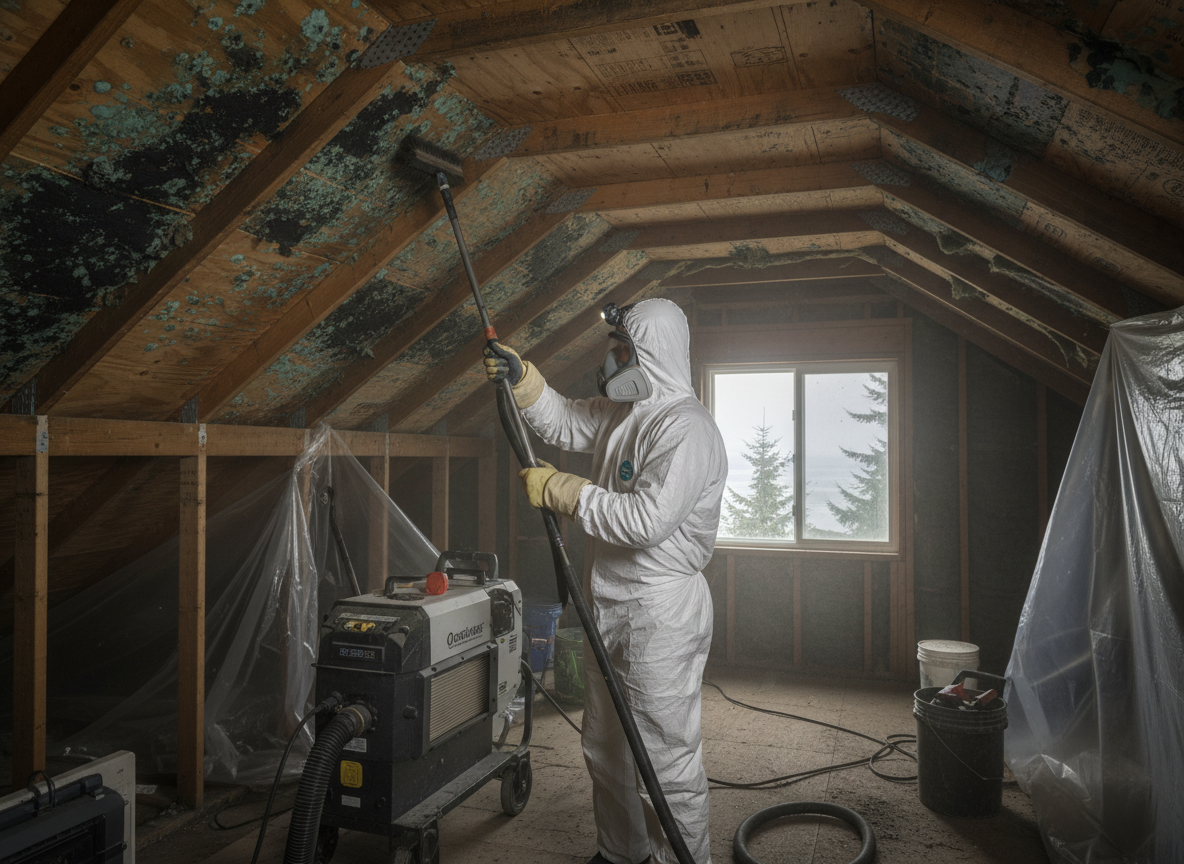
Camano Island homes, many built between the 1960s and 1980s with cedar siding and fiberglass batt insulation, trap moisture when roof leaks or ridge-vent blockages allow winter rain to penetrate. Attic mold remediation here begins with moisture mapping using pin and pinless meters to locate hidden saturation behind baffles and along collar ties before any material is disturbed. Containment uses 6-mil poly barriers sealed to the ceiling plane because open truss designs common on the island allow spores to drift into living spaces below during removal.
Removal focuses on affected sheathing and insulation rather than surface spraying alone. When mold has colonized OSB or plywood roof decking, affected sections are cut out and replaced to restore structural integrity; simply fogging leaves the cellulose or fiberglass reservoir intact and ready to regrow once humidity climbs again. Post-remediation, negative-air machines with HEPA filtration run until readings drop below 1 % moisture content, a threshold required before new insulation can be installed without immediate failure.
Homeowners often overlook the role of bathroom exhaust fans venting into the attic, a frequent issue in Camano Island’s older stock. Correcting those terminations to the exterior during remediation prevents recurrence that would otherwise require repeat visits every wet season. All work is performed with the understanding that Camano Island sits in a marine climate where even brief sunny periods do not dry enclosed attic spaces quickly enough to stop mold growth once it has started.
Technician insight
In Camano Island, the thing that catches most people out with attic mold remediation is older homes where bathroom fans still vent into the attic; the constant marine humidity from Saratoga Passage keeps the space damp long after any visible leak is fixed, so the fans have to be corrected or the mold returns every winter.
Hidden Attic Mold After Roof Leak
A Camano Island homeowner noticed ceiling stains after heavy November rain. Inspection revealed mold growth across fiberglass batts and OSB sheathing where a ridge vent had been blocked by debris. The team contained the attic, removed the wet insulation and affected decking, sealed the leak, and rerouted two bathroom fans to the exterior before replacing insulation and verifying clearance.
How it works
- 1
Moisture Mapping and Inspection
Technicians access the attic from Camano Island homes and use meters plus thermal imaging to identify all wet zones and active leaks.
- 2
Containment Setup
Six-mil poly barriers and negative air are installed to isolate the attic from the rest of the structure before any material is removed.
- 3
Mold Removal and Source Repair
Contaminated insulation and affected sheathing are removed, roof leaks are sealed, and exhaust terminations are rerouted outside.
- 4
Drying and Clearance Testing
Dehumidifiers and air movers run until moisture content meets industry standards; air samples confirm spore levels have returned to normal.
- 5
Insulation Replacement and Prevention
New insulation is installed only after clearance, and ridge and soffit ventilation are verified to handle Camano Island’s frequent rain.
Pricing
Pricing varies with attic access difficulty, amount of insulation to replace, and whether roof deck repairs are required.