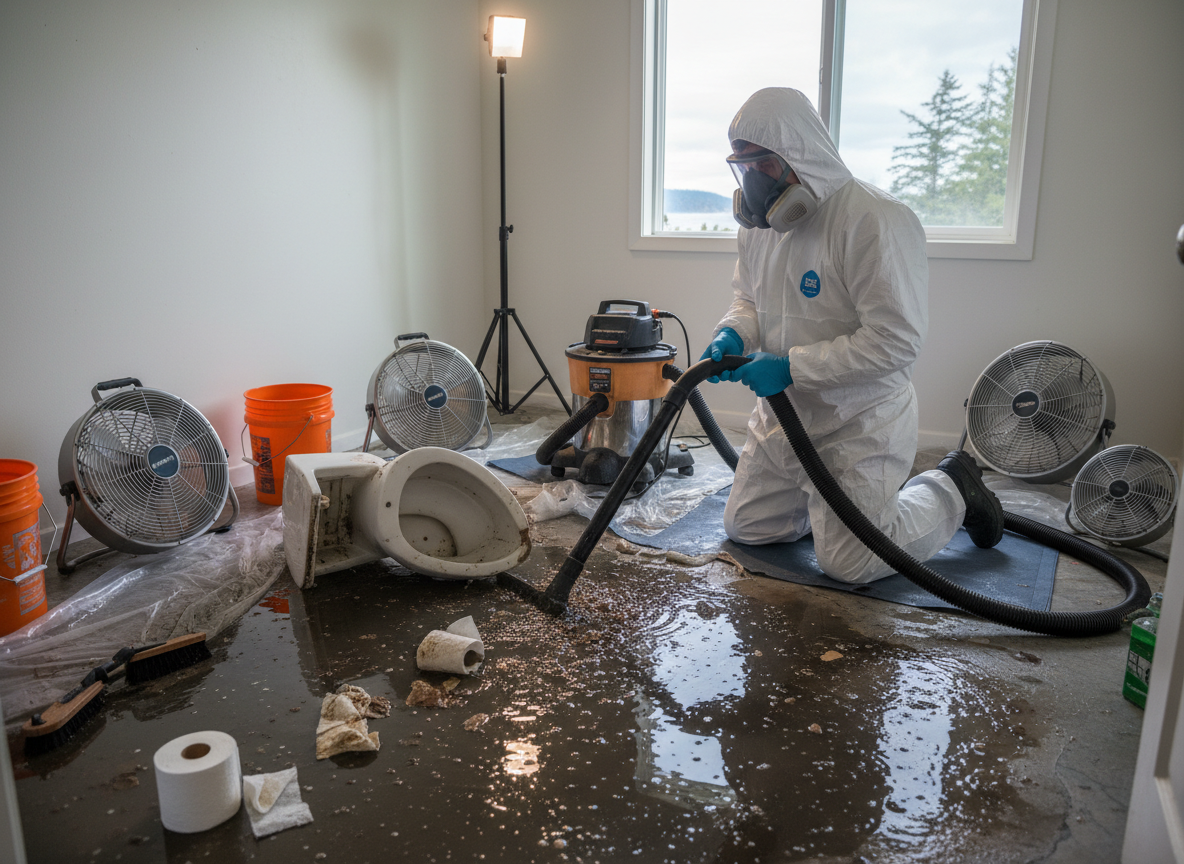
Toilet overflows on Camano Island often involve homes built before widespread municipal sewer lines, where septic tanks and drain fields sit close to the surface. Water can migrate quickly through pier-and-beam floors common in waterfront neighborhoods, reaching insulation and joists within hours. Technicians must map the flow path immediately because Island County soils retain moisture longer than mainland clay, raising hidden mold risk under cabinets and along baseboards.
Standard extraction with portable pumps is only the start. Crews lift vinyl or tile to expose plywood, then use moisture meters on every affected joist because cedar and fir framing in 1970s-era Camano homes wicks water differently than newer engineered lumber. Antimicrobial application follows, but only after confirming the septic system has not backed up; introducing high-volume cleaners into an already saturated drain field can push effluent into yards or crawl spaces.
Edge cases include overflows that reach adjacent bedrooms through shared walls in duplexes near Camano’s north end. In those situations, negative air machines run for several days while contents are inventoried and relocated. Homeowners are advised to shut off the main water valve at the first sign of rising water, since older gate valves at the street often leak and prolong the event.
Technician insight
In Camano Island, the thing that catches most people out with toilet overflow cleanup is how fast water travels under older pier-and-beam homes straight into the septic drain field. Homeowners often keep running water to flush debris, which overloads the tank and pushes effluent back into the crawl space.
Bathroom overflow into crawl space
A Camano Island homeowner reported rising water after a toilet overflow. Inspection showed water had entered the crawl space through gaps in the 1980s subfloor and reached the edge of the septic drain line. Extraction and targeted drying prevented saturation of the field; sanitation and dehumidification restored the space without excavation.
How it works
- 1
Initial Assessment
Technician arrives within hours, locates the source, and checks septic conditions before any extraction begins.
- 2
Water Removal
Pumps and wands extract standing water from flooring and subfloor cavities while protecting nearby drain fields.
- 3
Drying and Monitoring
Air movers and dehumidifiers run while moisture readings are tracked daily on joists and wall cavities.
- 4
Sanitation and Restoration
Antimicrobial treatment is applied, followed by selective demolition only where needed and final drying verification.
Pricing
Upfront quotes provided after inspection; cost varies with square footage, septic involvement, and drying time required.